
Sensor fusion brings together information from different sensors. This helps the driving system interpret a situation using several complementary perspectives rather than relying on a single view.
09/09/2026
- 5 min.
DECODED: Why do modern cars need so many different sensors?
No single sensor sees it all. Discover why automated driving relies on multiple perspectives.
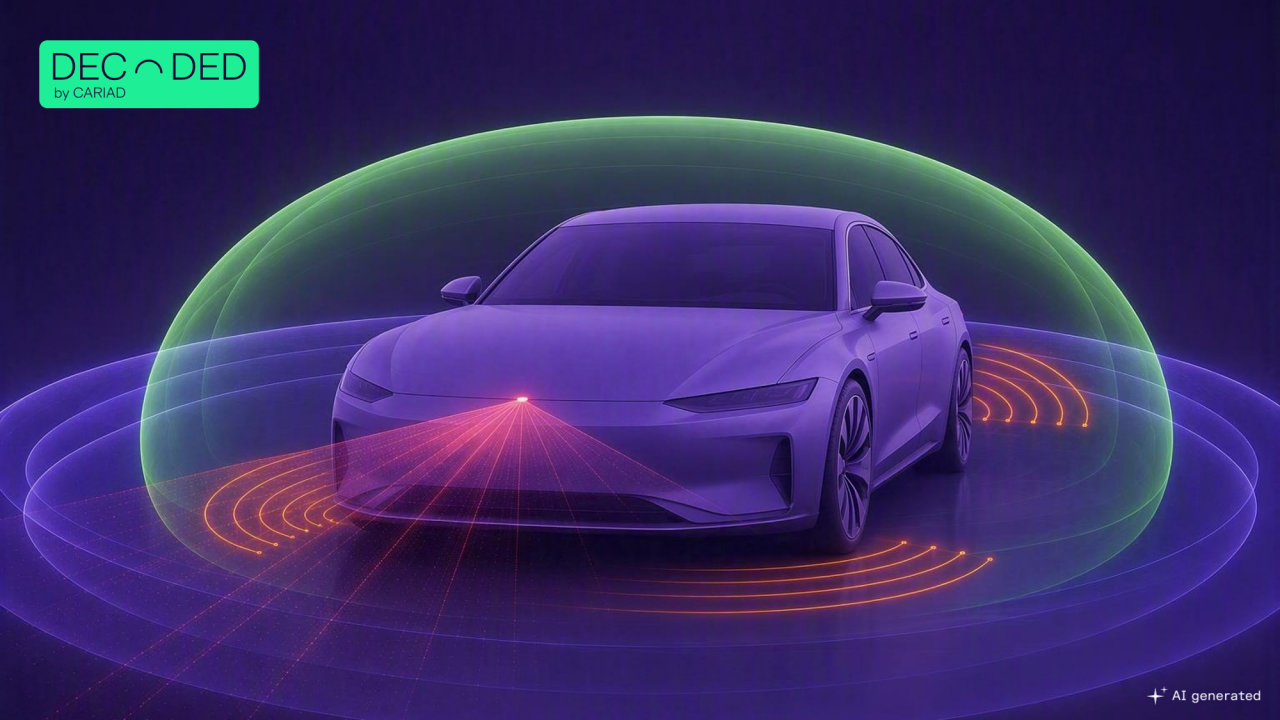
A bright winter morning. The road is wet; the low sun reflects off the surface and a car ahead starts to brake. A person approaches a crossing. Somewhere nearby, an emergency vehicle is getting closer.
Drivers use several senses to understand this situation. We look at the road, judge distances, notice movement and listen for warning signals. Automated driving systems face a similar challenge but rely on sensors placed around the vehicle.
So why does a car need so many different sensors?
The answer is not simply that more sensors enable more automation. No single sensor can capture the surroundings completely, precisely and reliably under every condition. Each one provides a different perspective. Combined, they create a more robust picture than any sensor could provide alone.
"Automated driving is not about having more sensors. It is about combining the right sensing principles for the intended functions, automation capabilities, and cost-efficient deployment. Cameras, radars and lidars each contribute unique strengths, creating a more robust understanding of the environment than any single sensor could provide alone,” explains Andreas Ortenreiter, responsible for the sensor set at CARIAD.
One road, several ways of sensing it

- A camera works in a way that feels familiar to us. It captures visual details such as lane markings, traffic lights, signs, colors and the appearance of objects. This helps the system understand what it is seeing.
- Radar asks different questions. Using radio waves, it measures the distance and relative speed of objects. It can track the vehicle ahead and even work in conditions that makes visual perception more difficult, including darkness, rain or fog.
- Lidar, short for light detection and ranging, uses laser pulses to create a precise three-dimensional view of the surroundings. While radar is particularly strong at tracking movement, lidar provides more detailed information about an object’s position, depth and shape. Put simply: radar measures how objects move, while lidar maps where they are and what their spatial contours look like.
- Ultrasonic sensors focus on the immediate area around the car. Their short range makes them well suited to parking and other low-speed maneuvers, where even a small distance to an obstacle matters.
- Microphones add another type of information: sound. They help the system detect acoustic warning signals, such as an approaching emergency vehicle, even before that vehicle enters the direct field of view.
Hence, there is no universal “best sensor”. There is only the most suitable combination for a particular vehicle, function and operating environment.
Different situations need different perspectives
When you are driving on a multi-lane road, a camera can identify the lane markings while radar measures the distance and movement of the vehicle ahead. Side cameras and corner radars help monitor neighboring lanes and approaching traffic.
Parking poses a different challenge. Cameras provide a wider view, while ultrasonic sensors measure nearby obstacles.
Conditions can also change the balance. A camera may struggle with low sunlight, darkness or heavy rain. Radar does not depend on visible light, so it can continue to measure distance and movement. But radar cannot read the color of a traffic light or interpret painted lane markings.
What one sensor finds difficult, another may still handle well. That is the strength of combining different measurement principles.
Different perspectives also support safety
A diverse sensor set is not only about performance. It can also reduce reliance on a single source of information. A camera lens might be dirty or temporarily blinded. Another sensor could be obstructed or report an error. Important objects can therefore be observed from more than one perspective. A camera may recognize the vehicle ahead, for example, while radar independently measures its distance and movement.
This does not mean that every sensor can replace every other one. Radar cannot read a traffic sign if a camera is unavailable. Instead, the system must understand which information remains reliable and whether the driving function can continue safely.
But equipping every vehicle with every available sensor would not make sense. Each sensor affects cost, space, energy use and computing requirements. The right sensor set balances functionality, reliability and efficiency.
The real intelligence starts when the data comes together
Sensors do not understand traffic by themselves. They produce images and measurements. Software connects this information and turns it into a coherent view of the surroundings.
This process is called sensor fusion. It combines information from different sensors into an environment model that can describe moving road users, stationary objects, drivable space and elements such as signs or lane markings. In addition, other sources such as map information also contribute to the overall picture.
What is sensor fusion?
A camera may recognize a red light. Radar may track the vehicle braking ahead. Lidar may add precise depth, while side sensors detect traffic approaching from another direction.
Together, they provide something no single sensor can offer: a more complete and reliable understanding of the road.
That is why cars need different kinds of sensors. Not because quantity is the goal, but because confidence comes from combining perspectives.

Share this article


-
The car that gives everyone their own weather
 Five zones share one climate unit in the Audi Q9. Here is how the software keeps the driver cool, the kids warm and the third row in the game.19/10/2026
 -
DECODED: What is driving dynamics?
 The three kinds of motion behind every drive, and the software that keeps them in sync.22/09/2026
 -
Germany's hottest streets 2026
 Last time, the fleet data showed which city runs hottest. Now the same sensors ask the sharper question: which street?01/09/2026