
Flap control sets how far a flap is open. Mass flow control sets how much air is requested for each outlet. The software works out the total amount of air the cabin needs, splits it between the outlets and moves blower and flaps together, so a change in one zone stays in that zone.
19/10/2026
- 7 min.
The car that gives everyone their own weather
Five zones share one climate unit in the Audi Q9. Here is how the software keeps the driver cool, the kids warm and the third row in the game.
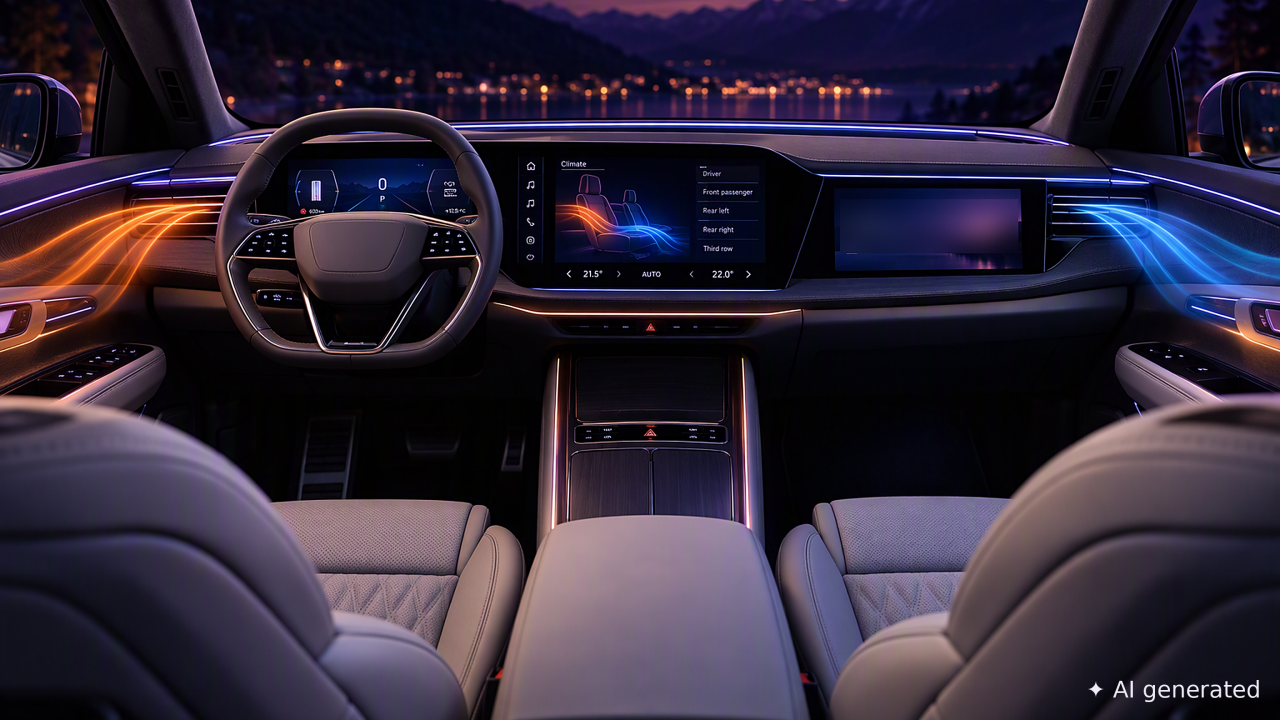
Somewhere on the motorway to the Alps, a family of five is having the oldest argument in motoring. Dad is sweating, the kids are freezing, and whoever reaches the dial first wins. In the new Audi Q9 that fight is over before it starts, because everybody gets their own dial.
Who owns the dial?
For most of automotive history, climate control had one setting for the whole car. The front got to decide and the back got to live with it. Rear vents helped a bit, but a warmer second row usually meant a warmer driver as well.
Today almost all of that behavior is written in software. Most drivers leave it on Auto 22 and forget it exists, which is exactly the point. When people do touch it, it is usually one degree up or down. The rest should happen quietly in the background: head cool, feet warm, and nobody asking for a blanket.
Paul Seelmann is a senior embedded software developer at CARIAD. His team writes the climate control software that runs in cars across the Volkswagen Group, from Audi to Porsche and Bentley. He compares his job to a defensive midfielder in football. If he does it well, you never talk about him after the match.
Five zones, one box of air
The Q9 is Audi's first large full-size SUV, and it is the first Audi to offer five-zone automatic climate control. Driver, front passenger, rear left, rear right and third row each get their own temperature and their own blower level. The catch is that all five zones pull air from the same climate unit through the same set of ducts.
In many cars, the unit is steered by classic flap control. Inside it, between 9 and 17 actuators move the flaps for the foot outlets, the side vents, the windshield and so on. The software sets each flap to a position, say 50 percent. Now the passengers in the back ask for more air. There is no separate blower in the rear, so that air has to come from the same unit up front. The front flap has no reason to move. It stays at 50 percent, more air pushes through it, and the front seats get a stronger airflow even though nobody there asked for it.
The Q9 works with mass flow control. Here the software knows how much air should come out of every single outlet. When the rear asks for more, it raises the blower and closes the front flaps a little at the same moment. The extra air goes to the back, the front stays as it was. On top of that, the car checks which seats are occupied and which zones need to be served at all.

With flap control, a rear airflow request also sends more air to the front seats (orange). With mass flow control, the front stays unchanged (green) and only the rear gets more. Schematic.
What is mass flow control?
A controller with a lot on its mind
The inputs you see on the screen are only the start. Per zone, passengers pick a temperature, a blower level and a climate style: soft, medium or strong. The car adds what it measures itself: the temperature inside and outside, the humidity inside and outside and, just as important, the sun.
A sun sensor in the base of the rear-view mirror reads the left and right side separately. Other functions use GPS to work out where the sun stands in relation to the car, which tells the software which rear seats sit in the light. With the sun behind the car, the rear left passenger may need more cooling than the person next to them. Anyone who has ridden in a sunny back seat in July knows how big that difference is.
Behind all this sit between 4,000 and 5,000 parameters, curves and maps in the climate control software alone. Most of them are tuned on test drives, usually by the car brands themselves. The mass flow parameters come from the team's own measurements. Engineers put funnels over the vents and use vane anemometers to record how much air comes out of which outlet at which flap position, and those numbers go straight into the model.

Parameters, curves and maps
A parameter is one fixed value. A curve turns one input into one output, for example outside temperature into blower level. A map takes two inputs and returns one output. Tuning thousands of them is how the same code can feel right in very different cars.
Where physics draws the line
Software cannot cheat thermodynamics. Mixing flaps blend warm and cold air, and the evaporator can only cool so much. A sauna up front and an ice box in the back will not happen. Around the familiar 22 degrees, though, the system has plenty of room. Turn the display from 22 to 21 and the target might be air at the vent that is around three degrees colder. The controller then calculates the total airflow and how much of it each outlet should deliver.
At the extremes, the software has to make a call. Picture AC Max at 45 degrees outside. The evaporator cannot produce enough cold air for every outlet at once. For a limited time, the software decides where the available cooling does the most good, so the cabin as a whole gets comfortable as quickly as possible. Once the system has caught up, every zone is back to its own setting.
Speed matters as well. If you say it is too warm, you want to feel it now. The air at the vent changes right away, even while the evaporator is still catching up. After the car has stood in blazing sun or hard frost, dedicated start-up functions recognize the situation and push harder for a short time. For all of this the climate software talks constantly to thermal management, which runs the evaporator and heating circuit and reports back what it can deliver.
Vents that move on their own
The Q9 also has electric air vents. In the vent band to the left of the driver and in the center, motors now move the lamellae. On the touchscreen you see the dashboard vents with a stream of air coming out of them, which the team calls the air carpet. Drag it from bottom left to top right and the real lamellae follow your finger.
Presets save everyone some fiddling. Some people love a direct breeze, others turn every vent away from their face. Preset one for you, preset two for your partner, done. In modes like AC Max, the software moves the vents itself. It also follows a rule most people would agree with: when the car is heating, the center vents stay shut, because nobody enjoys hot air in the face. A fanning function that slowly sweeps the air through the cabin is next on the list.
The third row gets a vote
In many large SUVs with extra seats in the trunk, the people in the very back got whatever air drifted over the second-row backrests. There was little or nothing for them to adjust. With the Q9, the climate control was developed with a strong focus on the third row for the first time.
In the Q9 the third row is zone five. It has its own vents, its own flaps and its own control panel in the back, and the seat-dependent climate control treats it like every other zone, with its own temperature and blower level. If you were the kid wedged into the back on every summer holiday, you will get why this matters.

Zone five: the third row gets its own vents, flaps and controls. AI generated.
Voice and cleaner air
Voice control has changed how people use the system. Say you are cold, or that your hands are cold, and the car makes a small offset without dropping out of Auto. Ten years ago, many drivers would have switched Auto off in that moment. Depending on the equipment, sensors also check particles and gases outside. When the air turns bad, the car can switch to recirculation, suggest closing the windows and flush the cabin with fresh air once things outside have cleared.
Same code, different cars
Few Q9 drivers will know how far their climate software travels. The same software platform also runs in other Group models such as the Audi Q7, the Porsche Cayenne and the all-electric Porsche Macan. Each car behaves differently because each gets its own data set. Whether a car has two climate zones or five, it runs the same code, tuned with different parameters.
This is how the Volkswagen Group wants to build software in general: write a function once, then tune it for many brands and models. In the climate team that approach rests on a lot of experience. Some colleagues have worked on it for 15 years or more, and extensive testing by the car brands keeps refining the tuning.
Feel is the hardest part to get right. When the team compared cars from several manufacturers, the feature lists looked much alike. On the road they did not. In some cars, Auto 26 felt almost the same as Auto 23. The team's own standard is simple: if you change a number on the display, you should feel it.
“Good climate control is like a good defensive midfielder. Nobody talks about it, but the game falls apart without it. We want every tap on the screen to be something you can feel, in every seat, right back to the third row.” says Paul Seelmann, Senior Embedded Software Developer at CARIAD
Why the cabin keeps getting more important
Whether it is the daily commute, a long holiday drive or a break at the charging station, people spend hours in their cars. Passengers talk, rest or look out of the window, while the driver needs to stay focused on the traffic. At home, a flat at 29 degrees during this summer's heatwave was enough to ruin anyone's week. In a car it is no different.
For many people, the climate control software in the Q9 works invisibly in the background. It spots the sun on the rear left seat, keeps the rear airflow away from the front seats and gives the third row its own controls. On the way to the Alps, nobody reaches for the dial anymore.
“If the climate isn't right, you simply don't feel comfortable in the cabin. The right climate is about more than feeling good. It also helps the driver stay focused on the road.” Paul Seelmann, Senior Embedded Software Developer, CARIAD

Share this article


-
DECODED: What is driving dynamics?
 The three kinds of motion behind every drive, and the software that keeps them in sync.22/09/2026
-
DECODED: Why do modern cars need so many different sensors?
 No single sensor sees it all. Discover why automated driving relies on multiple perspectives.09/09/2026
-
Germany's hottest streets 2026
 Last time, the fleet data showed which city runs hottest. Now the same sensors ask the sharper question: which street?01/09/2026