
Managing one of the largest internets of vehicles
How CARIAD uses in-house technology to power Volkswagen Group’s connected vehicle fleet around the world – and can handle vast amounts of signals provided by millions of vehicles.
The Internet of Things (IoT) has become an invisible backbone of modern life, connecting billions of devices globally - from factory robots to smart home appliances. But what happens when those things are cars? And not just a few thousand, but tens of millions of vehicles spread across the globe?
CARIAD manages one of the largest automotive IoT networks in existence: with more than 45 million connected vehicles across multiple brands of Volkswagen Group.
Behind the scenes, this vast digital ecosystem enables features that drivers use every day, often without realizing the complexity involved. Emergency features like the eCall, seamless route planning from a mobile app to the car, as well as remote diagnostics are just a few examples. These services rely on sophisticated cloud and connectivity solutions that ensure every bit of information reaches its destination—securely, reliably, and almost in real-time.
MQTT as a backbone of Automotive IoT
Managing connectivity for millions of vehicles is no small feat. Cars operate in challenging environments: they move through areas with patchy coverage, rely on cellular networks where bandwidth is limited. And they handle vast amounts of data provided by their sensors and electronic control units, from radar to temperature sensors, battery information and much more. This means the automotive IoT network will have to handle high volumes of near real-time messages from lots of sources without draining energy or overwhelming systems.
This is where MQTT (Message Queuing Telemetry Transport) comes in. While HTTP (Hypertext Transfer Protocol) powers the world wide web, MQTT has become the de facto standard for IoT communication. It is lightweight, efficient, and designed for constrained environments.
On the world wide web HTTP operates in a request-response model: clients send a request for specific information to a server, and the server is responding with an answer.
This concept isn’t suitable for the internet of vehicles. MQTT uses a publish-subscribe approach, decoupling senders and receivers through a broker. This architecture allows flexible communication patterns from many-to-many, one-to-many, many-to-one, making it ideal for large-scale IoT networks.
Instant notifications for all who need to know
For automotive applications, MQTT offers critical advantages: it minimizes data overhead on cellular networks, provides built-in reliability and even supports retained messages for synchronization when vehicles have lost connection to the network and must reconnect. In essence, MQTT can ensure that the right information reaches the right recipient at the right time.
Inside every modern vehicle, a plethora of sensors continuously monitors critical parameters such as tire pressure, battery health, temperature, or system performance. These sensors can act as publishers in the MQTT network, sending small, efficient messages to the broker whenever a value changes or an event occurs. The broker then routes these messages to the appropriate subscribers, which can include mobile apps, cloud services, diagnostic tools, or other control units in the car.
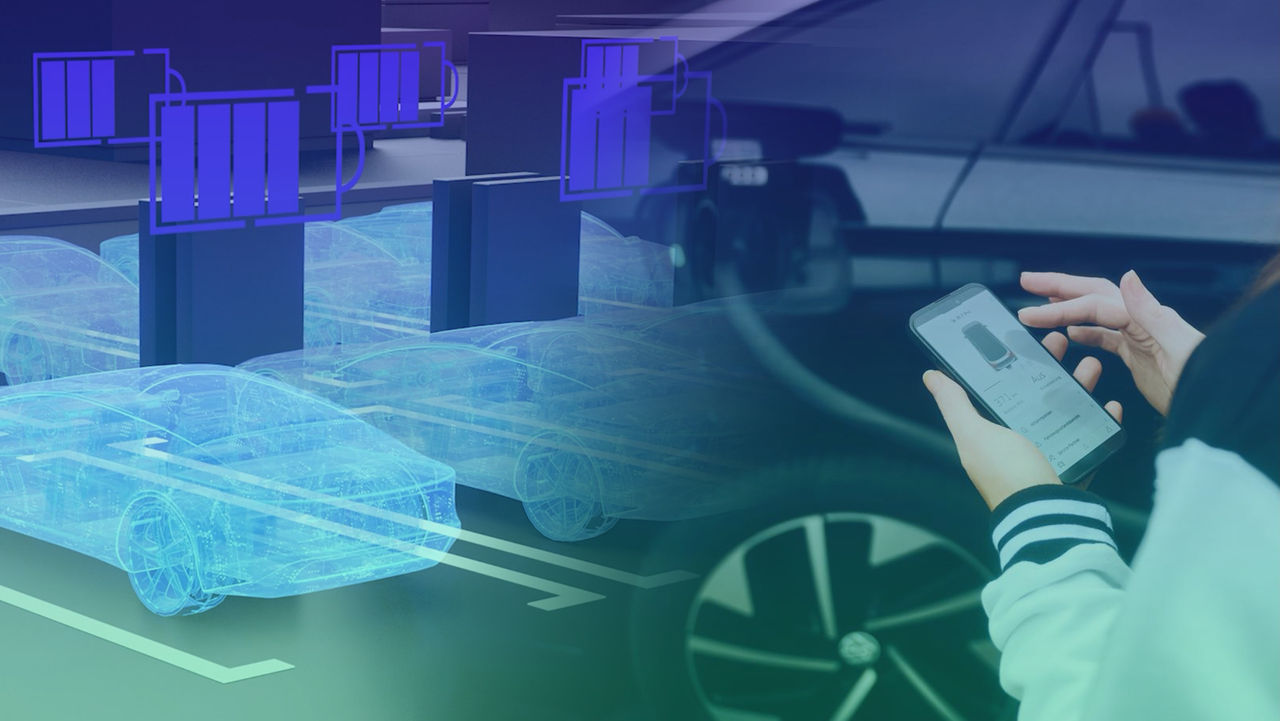
For example, the battery management controller (BMC) in an electric vehicle tracks the state of charge and regularly sends it to the broker. The driver’s mobile phone app has subscribed to this battery information and wants to display it. At the same time, the in-car navigation system has subscribed to battery information for its EV route planning as well. The MQTT broker infrastructure now ensures that the state of charge published by the BMC reaches both the driver’s mobile app and the in-car navigation system concurrently and in near real time.

In such a decoupled MQTT architecture controllers or sensors don’t need to know who will consume their information, they simply publish it. The broker handles distribution to the right recipients. The result is a highly scalable, reliable communication flow that keeps vehicles, services, and drivers connected without unnecessary complexity.
CARIAD’s Unique Approach: An In-House Broker
Using MQTT is one thing. Using it at the scale of tens of millions of vehicles is another. Traditional MQTT implementations often struggle with asymmetric messaging patterns, where millions of cars need to communicate with a smaller set of backend services.
To overcome these challenges, CARIAD teams from the US developed an own in-house MQTT broker in close cooperation with teams in Germany, specifically designed for Volkswagen Group requirements. It excels in many-to-one and one-to-many communication.
This custom solution handles massive concurrency - the vast number of messages sent by publishers in millions of cars at the same time - supports asymmetric communication patterns and avoids scalability bottlenecks. It’s optimized for efficiency, ensuring that every message, from a telemetry update to a remote command, flows seamlessly between vehicles and cloud services.
What This Means for Drivers and Developers
This technology isn’t just a backend marvel, it has features that make connected cars smarter, safer, and more convenient. Think of well-known services like unlocking your car remotely, pre-conditioning the climate before you step inside, or checking your battery status from your phone. These everyday conveniences rely on MQTT-based messaging.
Beyond comfort, MQTT enables critical functions like charging management, health alerts, and over-the-air (OTA) update orchestration. When a car needs a software update, MQTT coordinates the process, reporting progress and sending control signals to ensure everything runs smoothly. It also supports diagnostics, allowing developers and technicians to request logs or activate specific modes remotely, reducing downtime and improving service efficiency.
Future-proof for the software defined vehicle
The automotive environment is demanding. Cars are mobile, their internet connection is variable, and safety is paramount. MQTT addresses these challenges by providing lightweight communication, reliable delivery, and instant state synchronization. Its scalability and flexibility make it the perfect fit for an ecosystem as large and complex as Volkswagen Group’s connected fleet.
Managing one of the largest internets of vehicles isn’t just a technical achievement, it’s a strategic advantage. By building an MQTT broker in-house and tailoring it to Volkswagen Group needs, CARIAD ensures full control over critical technology, scalability for future growth, and flexibility to innovate new services. As vehicles become even more software-defined and AI-based features evolve, the ability to manage one of the largest automotive IoT networks efficiently will be a key differentiator.


-
The car that gives everyone their own weather
 Five zones share one climate unit in the Audi Q9. Here is how the software keeps the driver cool, the kids warm and the third row in the game.19/10/2026
 -
DECODED: What is driving dynamics?
 The three kinds of motion behind every drive, and the software that keeps them in sync.22/09/2026
 -
DECODED: Why do modern cars need so many different sensors?
 No single sensor sees it all. Discover why automated driving relies on multiple perspectives.09/09/2026