
Connected fleet reveals invisible black ice hotspots
The icy winter of 2026 made Germany's roads dangerously slippery. More than two million connected vehicles from the Volkswagen Group provided a precise picture of road conditions across the country.
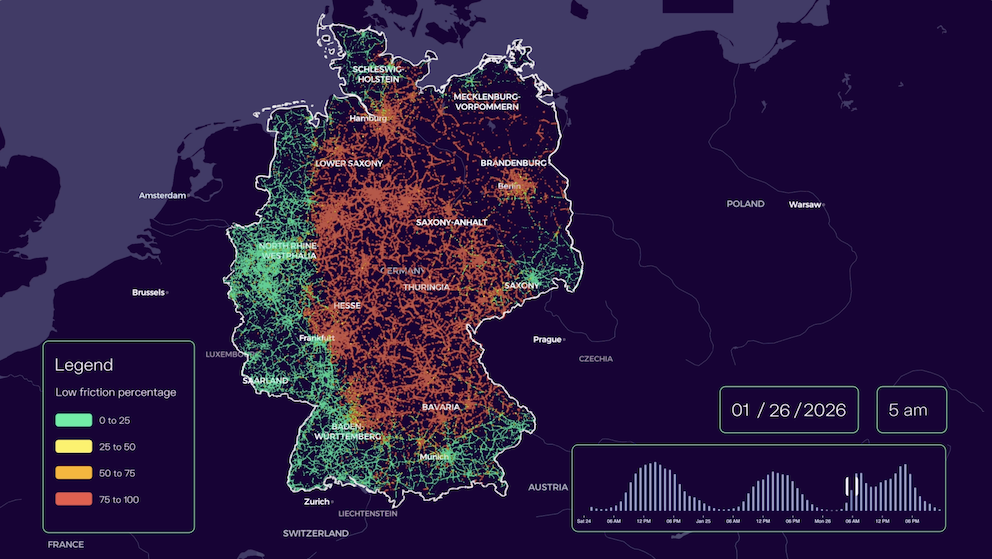
- Swarm intelligence: More than two million connected vehicles from the Volkswagen Group deliver a precise picture of road conditions during the icy winter of 2026.
- Hyperlocal insights: Data shows massive differences in slipperiness within individual city districts, for example in Munich and Berlin. Blanket weather warnings are often insufficient for accurate ice forecasts.
- Safety standard: Anonymized friction value data increases road safety and forms the backbone of automated driving.
The winter of 2026 was extremely cold. Heavy freezing rain and persistent frost made roads across Germany dangerously slippery. This is where the connected technology from CARIAD, the Volkswagen Group's software company, and its Swedish subsidiary NIRA Dynamics comes in. The system uses so-called friction value data. The friction value indicates how well the tires grip the road surface.
CARIAD and NIRA Dynamics analyze tens of millions of these data points from the fleet in real time every day. The system often detects slippery patches before they appear in weather apps. Drivers receive direct warnings in their cockpit, allowing them to adjust their speed in time – before it becomes dangerous.
Harsh winter 2025/2026: 7 times more slipperiness alerts than in the previous year
A look at the nationwide data shows just how exceptional the winter of 2025/2026 was. Between December 1 and January 31, the Volkswagen fleet in Germany registered around 2.54 million slipperiness alerts – an increase by a factor of 7 compared to the same period in the winter of 2024/2025 (360,116 alerts). This massive surge highlights how much worse road conditions were this winter and how essential precise real‑time data has become for road safety.
Data analysis: Slipperiness as a hyperlocal phenomenon
Evaluations of data from vehicles of the brands Volkswagen, Audi, Seat/Cupra and Škoda show that road slipperiness does not follow broad patterns but fluctuates significantly within very small areas.
In metropolitan areas such as Berlin and Munich, warning alerts varied greatly between districts from December 2025 to January 2026.

- Based on the rate of warning events per 100,000 kilometers driven, Berlin shows a striking east-west divide: while outer districts such as Marzahn Hellersdorf and Lichtenberg reach peak values of more than 30 events, Spandau in the west records fewer than 10 events.
- In contrast, the risk in Munich is heavily concentrated in the city center, particularly in the districts of Altstadt Lehel and Ludwigsvorstadt.

These strong local differences can be attributed to a combination of microclimatic factors, soil conditions, and structural characteristics. The friction value data generated by the vehicle fleet in real time makes these often invisible, small scale risk zones clearly visible and demonstrates that road slipperiness is not a widespread phenomenon, but one that is highly specific to certain locations.
While traditional weather services can usually only warn broad regions, fleet intelligence provides pinpoint data for specific road segments and alerts drivers individually and based on the situation.
Already in November 2025, the number of registered slipperiness warnings in Bavaria doubled compared with the previous year – an early indicator of the harsh nationwide winter that followed in January 2026.
Data for greater safety
The data from CARIAD and NIRA Dynamics directly supports drivers: vehicles from the Group's brands continuously measure the slip between tire and road. These anonymized values are transmitted to a central platform within seconds and immediately distributed to the entire fleet. Drivers receive warnings in the vehicle about local hazards ahead of them.
The harsh conditions this winter show how relevant real time information from the vehicle fleet is. We enable drivers to respond appropriately to the highly dynamic development of road slipperiness – and thereby increase overall safety.
gSebastian Franke
Product Owner Chassis & Road Conditions at CARIAD

All friction value data is processed exclusively for its intended purpose and fully anonymized in accordance with the GDPR and the EU Data Act. It is technically impossible to draw conclusions about individuals or profiles. The fact that the vast majority of users actively support data sharing underscores the high value placed on collective road safety.
The foundation for tomorrow's mobility
The insights gained this winter support not only today's drivers. They form the backbone of automated driving. Highly automated driving (Level 3) requires precise knowledge of the physical limits of the road. The ability to predict friction values in real time is a fundamental prerequisite for autonomous systems to make safe decisions and operate reliably, even under the most adverse conditions.


-
The car that gives everyone their own weather
 Five zones share one climate unit in the Audi Q9. Here is how the software keeps the driver cool, the kids warm and the third row in the game.19/10/2026
 -
DECODED: What is driving dynamics?
 The three kinds of motion behind every drive, and the software that keeps them in sync.22/09/2026
 -
DECODED: Why do modern cars need so many different sensors?
 No single sensor sees it all. Discover why automated driving relies on multiple perspectives.09/09/2026